Wednesday, 14 March 2012

ECO FRIEND

ECO FRIENDLY PRSSURE TEST
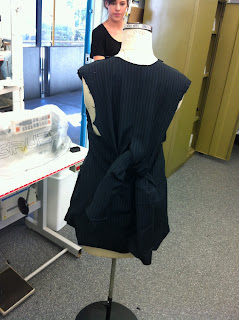
MADE FROM: 1 x man’s suit jacket with pants
TIME: 3 hours
TEAM: Katie and Faye

The idea of this pressure test is to use old garments from second hand stores to create something new.
­   First we looked at a few books for inspiration and through around a few ideas

­   Un-picked the suit

­   We had the idea of using the outer shell of the suit, but we have accidently placed the lining up against the fashion dummy Coco (but as most things happen for a reason), we decided to use the lining. We looked the piping and the pocket design of the lining.
­  


From there Faye and I started pining the fabric onto Coco
­   We wanted to create a dress with a bubble hem

­   To create the bubble we had two front panels and inserted a third panel to the middle of the skirt and turned the hem inside and stay stitched the dress to the side seam.

 The leg panels were used to complete the skirt section. 

­   We used the two front jacket panels as a cape, which buttons into the dress
­ 
  The two sleeves we cut and sewed together to create a scarf.

                     DIFFERENT WAYS TO WEAR THE DRESS:


JUNKY STYLING

JUNKY STYLING
 Philosophy: Generally, To keep producing amazingly sustainable designs… Junky’s ethos? Timeless, deconstructed re-cut and completely transformed clothing – forever
 
After Travelling  extensively the two designers were moved to start making clothes using old suits to go clubbing in.
This then progressed to making clothes for friends, which lead to a market and then a retail store.
They Say: We have always been running alongside the fashion business, as we don’t promote seasonal/ disposable clothes, but I think that there has been a movement towards more disposable high street chains in the 10 years of our business, which has subsequently lead to this fair trade backlash that we are now seeing in the form of Armani to M+S

Wednesday, 29 February 2012

WHAT IS?

WHAT IS?
FAD
Fashion that is taken up with great enthusiasm for a brief period of time; a craze.
A fad is when a large group of people adopt a certain fashion trend and follow it with keenness. This fashion trend is only adopted for a short time.
TREND
Trend [trɛnd]
·         General tendency or direction
·         Fashion; mode
A fashion trend mainly refers to anything which is popular in a culture at any given time. Fashion trends are generally speaking of style of dress, cooking, writings, art, architecture, fashion trends and many other popular factors. Fashion trends change very rapidly and "fashion" is often used to describe the latest version of these trends.
Fashion Classic
clas·sic/ˈklæsɪk/ Show Spelled[klas-ik] Show IPA
Adjective Also, classical
·         An artist or artistic production considered a standard.
·         A work that is honored as definitive in its field
A fashion classic refers to the staples in your wardrobe that are timeless, that you are always able to pull out and be able to wear. Due to these pieces being timeless involves them into being classic.  
CURRENT
FAD
Two tone denim:


TREND
A block of colour


CLASSIC
White shirt


FASHION CYCLE
Two tone denim 80s


The block of colour originated from the 1960’s


  British supermodel Twiggy

The white shirt first began in the 30s


BUBBLE UP or TRICKLE DOWN?
TWO TONE DENIM has bubbled up from the streets but it is the designer who has put the edge and placed the two tone denim into main stream.
BLOCK COLOUR trickled down from the designer trend.
WHITE SHIRT has bubbled up from the streets but it is the designers who take this design and changes it up for each changing season.


CULTURAL SIGNPOSTS
TWO TONE DENIM: Economic
BLOCK COLOUR: Social
WHITE SHIRT:  Economic, Political and Social


MOST INFLUENCES

IDENTIFY UP COMING TREND
BLOCK COLOUR I think the high street will take this idea and use as a pop of colour. In term means having one item of clothing being a block of colour.

1.)    TV           2.) MAGAZINES                                3.) ADVERTISEMENT
4.) INTERNET              5.)STREETS          6.) FAMILY  AND FRIENDS
7.) MOVIES                                 8.) MOVIE STARS              9.) FASHION INNOVATORS
10.) MUSIC VIDEOS      11.) CLUBS           12.) BILLBOARDS

Tuesday, 21 February 2012

START to FASHION MAGS


THE BEGINING OF FASHION MAGAZINES


An important part of the fashion industry is the fashion magazines. The fashion magazines can be a fashion designers bible and an in-look to the upcoming fashions. 

At the commencement of the 20th century, fashion magazines began to include photographs of various fashion designs and these people began to become more influential. These magazines were greatly desirable and had a weighty influence on public clothing taste. Artistic illustrators drew wonderful fashion plates for the magazines which had the most up to date fashion and beauty. 

Vogue was founded in the United Sates in 1892; it is the most successful fashion magazines. In the 1960s Vogue invested in colour printing which led to a huge boost in sales. This set the Haute couture designers to start a trend by designing ready-to-wear and perfume lines so they could advertise in the magazines. 

Fashion television coverage began in the 1950s with small fashion features. In the 1960s and 1970s, fashion segments on various entertainment shows became more frequent. Even with television and increasing internet coverage, fashion magazines coverage remains the most important form of publicity in the eyes of the fashion industry.

Over the past few years fashion websites have taken traditional writing and put it into online magazines. These magazines are sold via digital copies on the internet and on formats to be read on iPod’s, iPad’s and android. This way of reading magazines is coming more and more popular.

INFLUENCE FASHION MAGS


THE INFLUENCE OF EARLY FASHION MAGAZINES


In the 1060s American women could see original designs by fashion designer Charles Frederick Worth, in the popular publication Harper’s Bazaar. By the end of the twentieth century, this was the prime technique of spreading news of the new fashion trends from Paris.

 
Gowns were first illustrated with drawings. Vogue illustrated as many as 33 models from Paris in each issue, and about twice as many American dresses. Advertisements provided many more images. But as photography became more refined in the early twentieth century, the fashion press used more and more photographs of new designs. Fashion and art began to merge about the same time in the eyes of artists. These artists not only painted but also created textile designs and fashion illustrations. 

Vogue operated in America not only to provide sketches and patterns of fashions resulting from Paris models, but also to promote French couture. In America, wearing fashion from Paris would ensure that others would recognize the wearer’s wealthy status. Women liked what they seen in the pages of fashion magazines and were no longer content with dresses that were not recognized with the style of a particular fashion designer.

Today fashion magazines are similar influenced as they have been in the past. They are influenced by popular culture, music and economics. Actor, models and musicians and still showing more influence than world leaders. The world still watches Paris for next season’s fashion.